Fragile and conflict-affected states
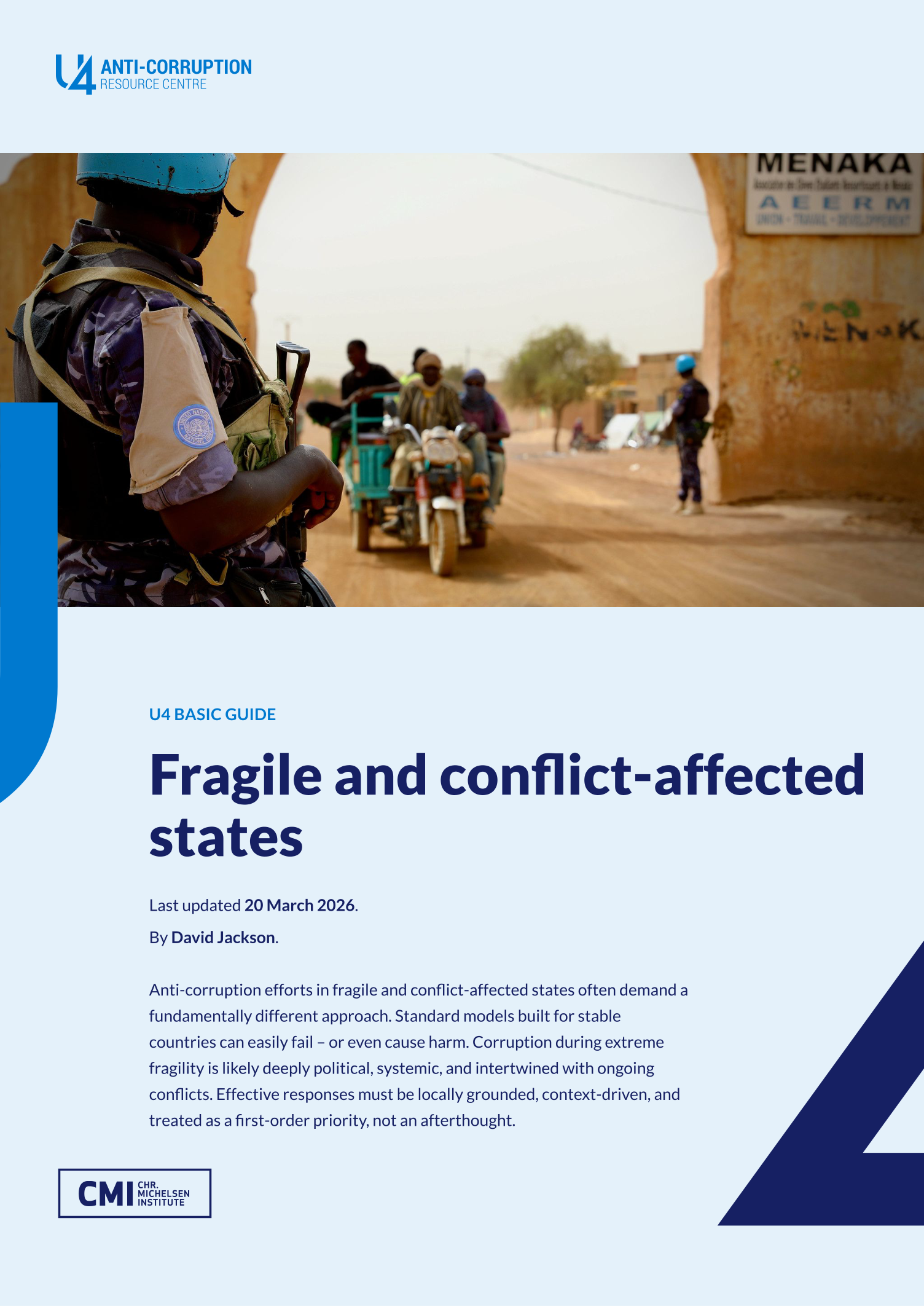
This guide is for anti-corruption efforts in the most extremely fragile societies. Extreme fragility refers to contexts where exposure to risks, such as violence, environmental shocks, displacement, and food insecurity, is extremely high and the capacity of states, systems, and communities to manage or mitigate those risks is extremely limited. Latent or active conflicts are often core aspects of fragility. The number of societies affected by high-intensity conflict is increasing.
Running anti-corruption initiatives is difficult in these settings, but progress is possible. However, anti-corruption approaches designed for stable countries may not work in the same way in conflict-affected settings – instead, standard programming models, concepts, and programming often need to change. This is a core message of the U4 three-week facilitated course on anti-corruption in fragile and conflict-affected settings.
This basic guide stresses the need to adapt strategies to the particular conditions of extreme fragility. It examines what counts as corruption, the nature of corruption, and why it matters for these settings. It explains why governance conditions are different, the range of anti-corruption possibilities, and core design principles.
What counts as corruption in conflict-affected states?
Defining corruption in conflict-affected settings is not always straightforward. A widely used definition describes corruption as ‘the abuse of public office for private gain’ – a definition that many international organisations and NGOs rely on.
But this term itself is very broad, encompassing many different practices. At one end are small informal payments to local officials. At the other are complex financial schemes involving senior political figures. Because the term covers such different behaviours, it can be more useful to describe specific practices rather than rely only on the general label of corruption.* Moreover, this common definition reflects a particular experience of state building in which the state is expected to act impartially and separate public authority from private interests. In many fragile contexts, political institutions have developed differently. Concepts such as ‘public’, ‘private’, and ‘abuse’ may be disputed.
People also understand corruption differently. Anthropological research illustrates this point. In Afghanistan, citizens who received aid described corruption in several ways. Some focused on the luxury of government offices. Others pointed to poor management or officials pursuing personal interests instead of community welfare.
Differences like these are sometimes misunderstood. External actors may assume that local populations do not recognise corruption. In practice, disagreements often reflect different political experiences and social norms. Assuming that outside actors must define corruption for others can create frustration and weaken reform efforts. Imagine an anti-corruption initiative in the education sector after conflict: External actors might classify informal payments to teachers as corruption. Yet in some contexts these payments may have helped teachers remain in their posts during instability. Similarly, the informal use of school resources may reflect coping strategies during crisis.
This does not mean that all definitions are relative or that the concept should be abandoned. Corruption involves actions that harm the public interest, particularly when public resources are used for private benefit. Many societies agree on this core principle – the challenge is knowing how to apply it in specific contexts. One must carefully analyse how corruption is understood and which behaviours generate the strongest concern.
Is corruption different in conflict-affected states compared to other development settings?
There is no single answer to whether or not corruption differs from conflict-affected contexts to other development settings. The nature of such environments can shape both the scale and the character of corruption, suggesting that there is a relationship between extreme fragility and corruption. This link is borne out in global rankings – such as the Corruption Perception Index – that tend to rate conflict-affected states among the worst performers.
Scale and character of corruption
Corruption tends to increase when opportunities exist, but constraints are weak. In many conflict-affected states, constraints are limited. Oversight institutions may be fragile, courts may function poorly, and authority may be fragmented. These conditions can increase corruption. At the same time, opportunities differ across contexts. Some fragile states have limited economic resources, which restricts opportunities for corruption. Others experience large inflows of aid, security spending, or resource revenues that create new opportunities.
Corruption can also differ in its basic characteristics. The table below shows a simple way to think about these differences.
Table 1. How corruption differs in its basic characteristics
|
Category |
Character |
Type of actors involved |
|
Opportunistic corruption |
One-off corruption involving just a handful of actors |
Public officials, contractors, citizens, politicians, managers |
|
Organised corruption |
Repeated corruption through institutionalised schemes |
Organised crime, large firms, senior politicians |
|
Policy subversion & capture |
Manipulation of policy decisions for private interests |
Large business interests, senior civil servants, judiciary, politicians, journalists |
|
Implementation capture |
Manipulation and appropriation of resources at level of delivery |
Mayors and local politicians, local officials, NGOs, international contractors |
|
Transnational corruption |
Collusion between domestic and international actors |
Professional enablers, banks, lawyers, politicians |
In some conflict-affected environments, corruption may be more systemic, meaning it involves multiple actors in a corruption system that is durable and operates according to stable norms and practices. Systemic corruption is more likely in conflict affected settings because norms around public office may also be less settled. In many stable states there is at least a broad expectation that public officials should serve the public interest. These norms are not always followed, but they exist as a reference point. In fragile and conflict-affected states, it is corruption itself that may proceed according to stable norms and rules because public-interest norms are less established.
Systemic corruption causes harm in two ways. The first is the corrupt act itself. The second is what happens next: to avoid being caught, those in power deliberately weaken or distort the very institutions that are supposed to hold them accountable.
Patterns of systemic corruption differ across contexts. Michael Johnston identified four broad corruption systems in fragile and conflict-affected settings:
- Official moguls
- Oligarchs and clans
- Elite cartels
- Influence markets
Each reflects different relationships between political power, economic resources, and institutions. The key point is that corruption in conflict-affected settings is often linked to wider political structures rather than isolated individual behaviour. Understanding those structures is essential for designing effective responses.
How important is corruption in conflict-affected and extremely fragile states?
Corruption is widely recognised as a serious issue in fragile and conflict-affected settings. Development agencies often apply enhanced safeguards and monitoring when operating in high-risk environments. Yet countering corruption is often not treated as a policy priority. In practice, governments and international actors usually see corruption as one challenge among many. As a result, it may receive limited political attention, expertise, and funding. Long-term strategies that place anti-corruption at the centre of programming are uncommon.
This means that anti-corruption measures are rarely mainstreamed into peacebuilding or sectoral programmes. For example, a study by U4 of 140 peace agreements signed between 1990 and 2023 found that only 7% explicitly mention corruption.
A report from the Special Inspector General for Afghanistan Reconstruction described anti-corruption efforts as too little, too late. There were moments when reform gained traction, especially when reform-minded officials held key positions. But progress was difficult to sustain once political support weakened or international attention shifted.
Research shows that corruption can become deeply embedded in aid and governance systems. Relegating corruption to a second-order position can defer problems to the future. A study by the Bonn International Centre for Conflict Studies described how patronage networks shaped aid delivery in Afghanistan between 2001 and 2021. International actors often relied on local power brokers to deliver assistance. Over time, this approach reinforced clientelist networks, and aid became a resource that local elites used to strengthen their authority within communities. Reporting corruption was often avoided because it created operational or political risks.
Why corruption matters beyond financial losses
There are understandable reasons for not making corruption a central focus in these settings. Governments and international actors often face urgent tasks such as stopping violence, responding to humanitarian crises, or restoring basic services. In these conditions it can seem unrealistic to address every governance problem at once. Some practitioners believe corruption is unavoidable in unstable environments. Investigating corruption may also be politically sensitive. In some situations, it is deemed that confronting it directly could threaten fragile political arrangements.
However, these assumptions deserve caution. In fragile settings, corruption is often closely linked to the political struggles that shape conflict and peace, suggesting corruption can be considered more of a first order problem – ie a primary cause of conflict. Though the relationship between corruption and conflict is multifaceted, research shows that corruption has an independent effect on conflict onset even when when accounting for factors such as economic conditions, political systems, and natural resources. Moving from low to very high corruption levels can more than triple the risk of armed conflict onset.
Corruption creates the perception that some groups benefit unfairly while others lose out. These perceptions can mobilise political opposition. Corruption can also weaken trust in public institutions. When citizens believe officials use public office for private gain, confidence in the state declines. This weakens the relationship between citizens and government. Research on protests in Iraq shows that anger about corruption played a central role in mobilising demonstrations.
Corruption can weaken institutions responsible for law enforcement and security. When this happens, potential rebels may believe the state lacks the ability to enforce order. Reports about ghost soldiers in Afghanistan revealed how corruption in military payroll systems inflated troop numbers and weakened the armed forces.
Corruption can also provoke a return to conflict. Large inflows of aid can exceed the administrative capacity of post-conflict states, increasing opportunities for rent-seeking and corruption when institutions are weak. Peace settlements may also have unintended consequences. Power-sharing arrangements can grant influence to former combatants. While these arrangements can help end violence, they may also reinforce patronage networks and rent-seeking behaviour, which can lead to entrenched corruption.
What makes anti-corruption work in conflict-affected states different?
As corruption is a cause of conflict efforts to reduce corruption matter – even in difficult contexts. But anti-corruption is not one thing. The goals, methods, and ambitions of anti-corruption is a choice. We suggest that it is important to not restrict anti-corruption to safeguarding funds.
While risk management may be important, it is also a limited approach. Evidence from Afghanistan indicates that the most important pathway for accountability of funds in these contexts is to invest in domestic capacity. Indeed, anti-corruption is much more than safeguarding or risk management: it should aim to create a better foundation for development. It should be thought of as an expansive agenda that covers accountability in public goods delivery, mainstreaming in sectors, and measures that can empose accountability on elites.
Governance conditions in fragile and conflict-affected settings: capacity, authority, and legitimacy
Every conflict is shaped by its own history and political dynamics. Still, countries affected by conflict and extreme fragility have certain governance pathologies. In turn, this fundamentally shapes the kind of corruption we see and the kind of anti-corruption that is possible.
A first point of difference between less fragile and more fragile societies may be state capacity, which refers to the ability of governments to carry out decisions and provide services. In the western understanding, a capable state has officials spread across the country, not only in the capital. It needs functioning ministries, trained civil servants, and clear administrative procedures. It also needs the ability to collect information and communicate decisions. In conflict-affected states, these systems are often damaged or incomplete. Government control may be limited to certain areas. Public institutions may struggle to operate or enforce rules. These limitations in statehood may give rise to more corruption, but not always. It does suggest that anti-corruption interventions that rely on an effective state will be less useful.
A weak state is not necessarily an ungoverned one – it can mean more presence of alternative forms of authority. Local elites, militias, or regional authorities may exercise control over different territories, and sometimes govern their areas with little accountability. Scholars have described this as warlord governance. At the same time, some alternative forms of authority may have more legitimacy than state actors, such as customary forms of authority.
In stable developing countries, public resources are usually distributed through formal systems such as ministries, budgets, and public agencies. In fragile contexts, these systems may not function reliably. In their place, informal institutions become more important. These are socially shared, unwritten rules that influence political behaviour and operate outside official laws and formal organisations. This does not mean that formal institutions disappear, butin fragile contexts there may be competing expectations about what public office means. Officials may face strong pressure to support their community, clan, or political faction. When resources are scarce, loyalty to these groups may take priority over national interests. Some scholars describe this as the 'politics of survival'. In such environments, distinctions between public and private resources can become blurred.
In some fragile settings, scholars argue for moving beyond the traditional conception of what a state is. Alexander de Wall has argued that we are better off seeing the state as a 'political marketplace', where leaders bargain over resources and alliances in order to maintain stability. These arrangements can sometimes reduce violence, but they can also reinforce corruption and make accountability reforms more difficult.
Anti-corruption efforts rely on political will. Research suggests that when elites believe they may politically benefit, they may support strategic improvements to governance. In conflict-affected settings, the future may matter less than immediate survival or advantage, and so short-term competition is likely to shape the most important political incentives. Control over resources can become a zero-sum struggle between rival groups. Trust between elites may also be low, especially if some actors profit from instability. The Democratic Republic of Congo and South Sudan are often discussed in this context, though their situations differ in many ways.
Anti-corruption intervention design: the range of possibilities
Anti-corruption includes efforts to reduce corrupt practices through both direct and indirect means. No single model works everywhere: effective strategies depend on context, timing, and political realities. Different approaches assume different paths to change. In practice, programmes often combine several approaches for which there are advantages and disadvantages.
Institutional approaches
Institutional approaches focus on rules, transparency, and enforcement. The aim is to make corrupt behaviour harder and more risky. This has long been the dominant model in anti-corruption work. Many programmes promote legal reform, stronger enforcement bodies, monitoring systems, and specialised anti-corruption institutions. For example, a 2025 UNODC guide for anti-corruption practice in conflict affected settings places institutions inspired by the UN Convention against Corruption at the centre of programme design.
However, the relevance of this model for extremely fragile states has been questioned. Some researchers argue that it reflects state building experiences from wealthier countries with stronger overall rule of law that may not translate well to fragile environments. Others suggest that programmes have sometimes been transferred from more developed contexts without enough attention to local political realities.
These critiques have sparked an alternative set of interventions ideas.
Indirect approaches
Indirect approaches do not address corruption directly. Instead, they try to change the broader conditions that allow corruption to flourish. These efforts may focus on improving governance systems, expanding access to information, strengthening welfare services, improving education, or supporting economic development. The idea is that these changes may reduce incentives for corrupt behaviour over time.
Indirect approaches can sometimes be useful when directly confronting corruption would provoke strong resistance. This can happen when powerful actors benefit from corrupt practices or when challenging those practices might destabilise fragile political arrangements. However, there is also a risk that organisations choose indirect approaches simply because they avoid the political challenges of addressing corruption openly. Indirect approaches tend to work best when they complement more direct measures or when direct engagement is not currently possible.
Sectoral approaches
Some programmes address corruption through sector-specific work. These are often called quiet approaches because they are embedded within a wider programme or setting. The focus is on specific practices that block progress in a sector such as health care, infrastructure, or energy reform. For example, a health programme might introduce transparency and accountability measures to reduce absenteeism or informal payments. These approaches can help prevent or reduce corruption in a particular programme. However, their impact usually stays within that programme or sector. They are unlikely to solve systemic corruption across the whole political system.
Social empowerment and collective action
Another group of approaches focuses on pressure from below. These strategies aim to strengthen the ability of citizens, civil society, and other actors to demand accountability. Some research suggests that corruption can become a powerful rallying point for collective action. Michael Johnston argued that enabling social empowerment requires expanding the political and economic resources available to ordinary citizens, alongside institutional reforms that strengthen transparency and accountability.
Related work from the SOAS Anti-Corruption Evidence programme highlights the idea of 'horizontal checks'. This approach seeks to support networks of actors who benefit from rule-following and therefore have an interest in pushing for enforcement.
Transnational approaches
Corruption in fragile settings often has international dimensions. Armed groups may use international financial networks, digital platforms, and illicit trade routes. Weak enforcement of anti-money laundering rules in wealthier countries can also provide safe places for illicit wealth. Sanctions can generate illicit markets. While they restrict access to global finance, they can also encourage smuggling networks and new intermediaries who profit from bypassing restrictions. For this reason, some anti-corruption strategies focus on action by other states. This can include reforms in aid-giving countries, measures that restrict illicit financial flows, or political pressure on corrupt elites.
Transformative reforms
Some analysts point to moments when major political change makes large scale reforms possible. These are sometimes described as ‘big bang’ reforms. In fragile settings, such opportunities may be rare and such engineering cannot be done by external actors. Even so, some analysts have pointed out that corruption in these settings cannot be tackled effectively through isolated reforms, control and monitoring mechanisms, or the replacement of political decision-makers. Instead, it requires a long-term, society-wide transformation. One report recommends that international actors should consider whether to pursue this transformation or not – assessing the risks associated with a non-transformative approach vs. any alternative measures.
Core principles of anti-corruption action
Understanding the context
Effective anti-corruption work in fragile and conflict affected settings begins with understanding the context. In recent years, many approaches have tried to improve this. These include:
- Conflict sensitivity
- Adaptive programming
- Social norms analysis
- Political economy analysis
- Gender analysis
In practice, however, organisations often struggle to use these tools well.
Programme teams rarely take the time to question their assumptions or test whether they fit the local context. Problem diagnosis should guide solutions. Yet programmes are often shaped by ‘solution-driven’ thinking. When designers are more familiar with certain interventions than with the local problem, they may define the problem in ways that match the tools they already know. This can lead to programmes that repeat familiar approaches rather than respond to local realities.
There are also practical pressures such as tight deadlines, etc. Copying programmes from one context to another is quicker than designing a new intervention each time. Therefore, similar models are repeated across very different settings, even though experience shows that one approach rarely fits all contexts.
Context analysis should guide decisions about what to do and how to do it. It can help identify which corrupt practices are most important to address and which are feasible to tackle. It can also clarify which actors influence these practices and what political or social norms sustain them. Just as important, it can help avoid programmes that unintentionally worsen conflict dynamics.
Moreover, it can help establish a gender perspective. Violent conflict often intensifies existing patterns of corruption and entrenched gender inequalities. Conflict dynamics, including displacement and the loss of livelihoods and assets, mean women are more frequently exposed to coercive and exploitative forms of corruption, including practices such as survival sex in displacement settings.
Do no harm
In fragile and conflict-affected settings, a ‘do no harm’ approach matters because well-intended interventions can unintentionally worsen corruption, reinforce harmful power structures, or increase tensions if they do not account for the local political and conflict dynamics.
Sometimes, development and peacebuilding assistance can strengthen illicit wealth and power. Institutional and democratic reforms emphasised by what is termed the ‘liberal peace’ model can unintentionally create corruption opportunities. These reforms often include elections, economic liberalisation, decentralisation, demobilisation, and security sector reform. They aim to stabilise societies after conflict. Yet if corruption is ignored, they may strengthen patronage networks or allow armed groups to retain influence in new institutions.
Decentralisation, for example, can shift opportunities for corruption to the local level when accountability systems are weak. Large inflows of aid can distort fragile economies. When institutions are weak and oversight is limited, rapid spending can increase fraud, patronage, and waste. International actors can also contribute to abuse. Peacekeepers, contractors, and aid workers have sometimes been involved in aid embezzlement, collusion with organised crime, or human trafficking.
Localisation
No single model works everywhere. Context analysis helps ensure that anti-corruption programmes reflect the realities of the place where they operate. Localisation means that local actors and conditions shape the priorities and design of anti-corruption work. Even in highly corrupt environments, local initiatives often exist. External actors can support these efforts, but they should avoid dominating them.
In conflict settings, the idea of ‘local’ can be complicated. People from another region of the same country may still be seen as outsiders. Different groups within the same area may have competing interests or distrust each other. For this reason, careful stakeholder analysis is essential. Programmes may also need to invest time in building trust and relationships among local actors, especially when working across conflict lines.
Summing up
Implementing anti-corruption efforts in these contexts is challenging, but not impossible. Approaches developed for stable environments often do not translate effectively to conflict-affected settings. Instead, commonly used models, assumptions, and programming strategies usually need to be adapted to fit the realities of fragility and conflict.
Disclaimer
All views in this text are the author(s)’, and may differ from the U4 partner agencies’ policies.
This work is licenced under a Creative Commons Attribution-NonCommercial-NoDerivatives 4.0 International licence (CC BY-NC-ND 4.0)